
Recently, I came across a heartbreaking post in an international sourcing Facebook group. A couple who had worked hard to launch their new project was scammed out of €500 right at the starting line by a fake “sourcing agent.” After taking the money, the scammer threatened them to remove their post and arrogantly claimed they would just change their phone number.
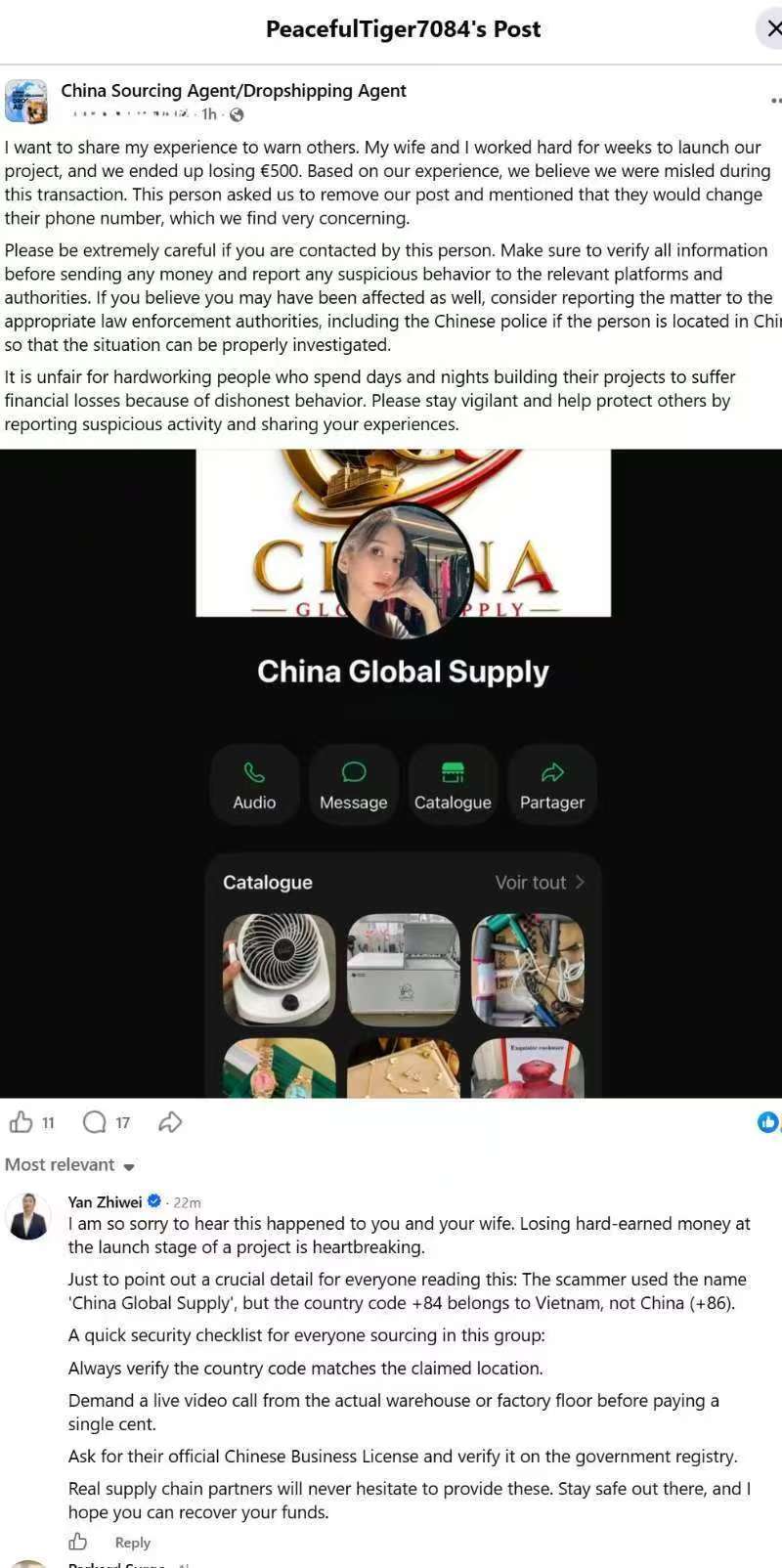
I left a reply under that post because a quick look at the scammer’s profile revealed a red flag. The scammer claimed to be “China Global Supply,” but the country code on their WhatsApp was +84 (Vietnam), not China’s +86.
While our team is busy in the warehouse every day inspecting goods and loading containers, there are scammers hiding behind screens, exploiting information gaps to steal from hardworking importers and buyers. To protect your funds, I have summarized the most effective, hardcore ways to expose them immediately based on my years of B2B Sourcing China experience.
1. Account Anomalies & The Real-Name ID Test
Let’s clarify an industry fact: If a supplier uses a non-+86 WhatsApp number, it does not automatically mean they are a scammer. To comply with platform rules or target specific markets, many legitimate Chinese factories and trading companies use overseas numbers (such as Hong Kong, Singapore, US, or European numbers). However, they rarely use Southeast Asian or South Asian numbers. That is why the +84 code was suspicious.
The Hardcore Test: If they use a foreign number, ask them why. Legitimate businesses will give a reasonable explanation. More importantly, demand their +86 phone number AND a photo of their Chinese ID card. In China, all +86 SIM cards require strict real-name registration bound to a unique ID card. For example, my name is Yan Zhiwei, which matches my real ID card photo and name, and my +86 phone number is strictly registered under this exact ID. Legitimate agents have multiple registered +86 numbers. Scammers will NEVER risk showing you their real ID and +86 number because it makes them easily trackable by Chinese authorities.
2. The Lowball Price Trap
When you ask for a quote, scammers often offer a ridiculously low price—sometimes cheaper than raw material costs—just to bait you into paying a deposit. Once you pay, they either make excuses to raise the price or ship you unsellable garbage.
Remember a basic business rule: Legitimate Chinese factories and sourcing agents do not do business at a loss. Behind us are physical factories, hardworking employees, and families to feed. We need a reasonable profit to survive; we are not running a charity.
Overly pursuing the lowest price will almost certainly lead you to scammers. For instance, when our team encounters “clients” who aggressively demand unrealistically low prices with zero regard for quality, we do not waste a single minute on them.
3. Identifying Professionalism Through Needs Analysis
Real Chinese factories and sourcing agents focus heavily on how to serve you well. In the early stages, a legitimate agent will patiently and professionally discuss every detail of your needs: materials, tolerances, custom packaging, and the pros and cons of different logistics plans.
Scammers, on the other hand, lack the time, patience, and professional knowledge to discuss these technical details. They will simply say “yes” to everything you ask just to rush you to the payment stage.
4. Payment Timing and Processes
When an agent asks for money is a crucial indicator of their legitimacy.
We, as legitimate Chinese agents, will never desperately rush you to pay. In our company, I strictly require my team to confirm all product details, logistics solutions, and the Proforma Invoice (PI) before asking the client for payment. Why? Because if there is a misunderstanding and we need to issue a full refund, it costs us massive international banking fees and wastes our time. Scammers do the exact opposite—they send their payment info before the details are even finalized.
5. Unannounced Live Video Calls
This is your ultimate weapon to filter out fake companies. Never accept pre-recorded videos! Demand an unannounced live video call on WeChat or WhatsApp during Chinese working hours. Tell them: “Walk around your warehouse or factory floor right now, and show me the products.”
Real agents who execute strict quality control processes on the ground love this request because it proves our capability. Scammers sitting in a bedroom will immediately make excuses.
6. Stick to the Bottom Line of Corporate Bank Accounts
Many beginners think PayPal or credit cards are safer. In real Chinese B2B manufacturing, the exact opposite is true! Legitimate Chinese factories and export companies DO NOT accept PayPal for bulk B2B orders. We strictly stick to the bottom line of using official corporate accounts. We only accept T/T (Bank Transfer).
Here is a critical detail: Due to translation differences and local policies, the English company name on the PI or corporate account may not perfectly match the Chinese name on the Business License character by character (e.g., our Chinese name is “深圳市嘉会四海科技有限公司”, and the corresponding English name is “Shenzhen Jiahui Techenology Co.,Ltd”).
How to verify securely? Any legally compliant enterprise in China has its true information recorded and publicly available in the official government system. Simply visit China’s official verification website—National Enterprise Credit Information Publicity System (https://www.gsxt.gov.cn)—and enter their Chinese company name or unified social credit code. As long as the enterprise status is [Active / 存续], it is a legitimate operating business. If it shows [Revoked / 吊销] or [Abnormal / 异常], stop paying immediately!
Scammers exist, but if you strictly apply these rules—check real-name +86 numbers, analyze professionalism, demand live video calls, and verify their active status on the official government system—you will instantly spot the fakes. If you are looking for a 100% transparent, hardworking sourcing partner on the ground in China, please contact our team. We protect your business so you can focus on growing it!